Abstract
Understanding the drivers of geomagnetic storm activity is essential for advancing space weather forecasting and mitigating the impacts of solar-terrestrial disturbances on technological systems. In this study, the influence of key solar and interplanetary parameters on geomagnetic storm occurrence was investigated through a correlation analysis between the yearly frequency of geomagnetic storms and selected indicators of solar and heliospheric activity. The parameters examined include hard X-ray solar flares, solar wind plasma pressure, coronal mass ejection (CME) occurrence, the F10.7 solar radio flux index, and the interplanetary magnetic field (IMF). The results reveal statistically significant positive relationships between geomagnetic storm frequency and all investigated parameters, indicating that enhanced solar and interplanetary activity generally promotes increased geomagnetic disturbances. Among the studied variables, the strongest correlation was observed between geomagnetic storm frequency and the yearly mean IMF (r = 0.83), emphasizing the dominant role of interplanetary magnetic field conditions in storm generation and magnetosphere-solar wind coupling processes. A strong positive correlation was also found with solar wind plasma pressure (r = 0.73), suggesting that elevated solar wind dynamic pressure significantly contributes to geomagnetic storm occurrence. The F10.7 solar radio flux index exhibited a substantial positive correlation (r = 0.67), indicating that higher levels of solar activity are associated with increased geomagnetic storm frequency. Similarly, CME occurrence showed a positive correlation (r = 0.63), confirming the important contribution of large-scale solar eruptive events to geomagnetic disturbances. Furthermore, hard X-ray solar flare activity demonstrated a positive association with storm occurrence, highlighting the role of energetic solar eruptions in shaping space weather variability. The comparative analysis establishes the relative influence of the investigated parameters in the following order: IMF (r = 0.83) > Solar Wind Plasma Pressure (r = 0.73) > F10.7 Solar Flux (r = 0.67) > CME Occurrence (r = 0.63). These findings demonstrate that geomagnetic storm activity is governed by a complex interplay between solar activity and interplanetary conditions, with IMF variability emerging as the most influential factor. The study contributes to a deeper understanding of solar-terrestrial interactions and provides valuable insights for improving predictive models of geomagnetic storm occurrence and space weather hazards.
Keywords
Geomagnetic Storms, Interplanetary Magnetic Field (IMF), Coronal Mass Ejections (CMEs), Hard X-ray Solar Flares,
Solar Wind Plasma Pressure Activity
1. Introduction
Geomagnetic storms are major disturbances of Earth’s magnetosphere driven by enhanced energy, mass, and momentum transfer from the solar wind into the near-Earth space environment. These disturbances arise from complex solar–heliospheric–magnetospheric coupling processes and represent a central topic in space weather research due to their impact on satellites, communication systems, navigation, and power infrastructure. In general, geomagnetic storms occur when sustained southward interplanetary magnetic field (IMF Bz< 0) enables magnetic reconnection at the dayside magnetopause, allowing efficient energy injection into the magnetosphere
| [1] | Dungey, J. W. (1961). Interplanetary magnetic field and the auroral zones. Physical Review Letters. |
| [2] | Gonzalez, W. D., Joselyn, J. A., Kamide, Y., et al. (1994). What is a geomagnetic storm? Journal of Geophysical Research: Space Physics. |
[1, 2]
.
The primary drivers of geomagnetic storms are large-scale heliospheric transients, especially coronal mass ejections (CMEs) and their interplanetary counterparts (ICMEs), as well as high-speed solar wind streams (HSSs) originating from coronal holes and their interaction regions (CIRs). CMEs, in particular, are recognized as the most geoeffective structures due to their strong magnetic fields, embedded flux rope topology, and ability to maintain prolonged southward IMF conditions during Earth impact
| [3] | Kilpua, E. K. J., et al. (2017). Coronal mass ejections and geomagnetic storms. Living Reviews in Solar Physics. |
| [10] | Webb, D. F., & Howard, T. A. (2012). Coronal mass ejections: Observations. Living Reviews in Solar Physics. |
[3, 10]
. Recent studies of Solar Cycle 25 further confirm that CME-driven storms dominate extreme space weather events, often enhanced by sheath regions and magnetic cloud structures within ICMEs
| [7] | Richardson, I. G., & Cane, H. V. (2012). Solar wind drivers of geomagnetic storms. Solar Physics. |
| [11] | Zhang, M. et al. (2023). Numerical modeling of solar wind and CME in the inner heliosphere. Frontiers in Astronomy and Space Sciences. |
[7, 11]
.
Heliospheric propagation processes critically modulate the geoeffectiveness of solar eruptions. As CMEs travel through the heliosphere, they interact with the ambient solar wind, other transients, and large-scale structures such as coronal hole streams, leading to deflection, rotation, compression, and complex magnetic restructuring. These interactions can significantly enhance or suppress storm intensity at 1 AU depending on the resulting IMF orientation and dynamic pressure conditions
| [8] | Schwenn, R. (2006). Space weather: The solar perspective. Living Reviews in Solar Physics. |
| [11] | Zhang, M. et al. (2023). Numerical modeling of solar wind and CME in the inner heliosphere. Frontiers in Astronomy and Space Sciences. |
[8, 11]
. Recent event-based analyses of Solar Cycle 25 demonstrate that even moderate-speed CMEs can generate severe geomagnetic storms when heliospheric evolution produces favorable magnetic configurations, such as enhanced southward fields in sheath or flux rope regions
| [6] | Paouris, E. et al. (2025). How the CME on 21 April 2023 triggered a severe geomagnetic storm. arXiv: 2503.00705. |
[6]
.
In addition to CMEs, high-speed streams originating from coronal holes play an important role in recurrent geomagnetic activity. When fast solar wind overtakes slower streams, corotating interaction regions (CIRs) form, producing long-duration but moderate-intensity geomagnetic storms. These structures are particularly important during declining solar cycle phases, where recurrent geomagnetic disturbances become dominant
| [4] | MNRAS (2023). Geomagnetic storm forecasting from coronal holes. Monthly Notices of the Royal Astronomical Society. |
| [7] | Richardson, I. G., & Cane, H. V. (2012). Solar wind drivers of geomagnetic storms. Solar Physics. |
[4, 7]
. Recent modeling efforts have improved prediction capabilities by linking coronal hole morphology and IMF polarity to storm intensity, demonstrating measurable correlations between solar surface features and geomagnetic indices such as Dst and Kp
| [4] | MNRAS (2023). Geomagnetic storm forecasting from coronal holes. Monthly Notices of the Royal Astronomical Society. |
[4]
.
Modern heliospheric research increasingly emphasizes the importance of multi-spacecraft observations and advanced numerical modeling in understanding Sun–Earth connections. Missions such as ACE, WIND, SOHO, STEREO, and Solar Orbiter have enabled three-dimensional reconstruction of CME evolution across the inner heliosphere, revealing that CME rotation, deflection by coronal holes, and interaction with preceding solar wind structures are key factors governing geomagnetic storm strength
| [3] | Kilpua, E. K. J., et al. (2017). Coronal mass ejections and geomagnetic storms. Living Reviews in Solar Physics. |
| [11] | Zhang, M. et al. (2023). Numerical modeling of solar wind and CME in the inner heliosphere. Frontiers in Astronomy and Space Sciences. |
[3, 11]
. Furthermore, recent extreme storm events during 2023–2024 highlight that “stealth” CMEs and complex multi-ICME interactions can produce unexpectedly strong geomagnetic responses, challenging traditional forecasting approaches
| [5] | Pal, S. et al. (2025). Magnetic interaction of multiple ICMEs leading to a historic storm (May 2024). arXiv: 2508.16780. |
| [9] | Teng, W. et al. (2024). Unexpected major geomagnetic storm caused by faint flux rope eruption. Nature Communications. |
[5, 9]
.
Overall, geomagnetic storms are now understood as emergent outcomes of coupled solar–heliospheric–magnetospheric processes rather than direct one-to-one responses to solar eruptions. Their variability reflects the dynamic evolution of solar transients through the heliosphere, where magnetic topology, solar wind structuring, and interplanetary interactions jointly determine geoeffectiveness. Continued advances in heliospheric imaging, in situ measurements, and physics-based modeling are therefore essential for improving predictive capability and mitigating the risks posed by extreme space weather in an increasingly technology-dependent society. In present investigation we have studied frequency of occurrences of geomagnetic storms with higher energetic solar features and solar wind parameters to explore the characteristics of geomagnetic storms and their hezard effects on magnetospheric dynamics.
2. Data Sources and Methodology
In the present investigation, the relationship between intense geomagnetic storms, coronal mass ejections (CMEs), solar flares, and variations in solar wind plasma parameters was examined over the period 1997–2024, encompassing solar cycles 23, 24, and the rising phase of solar cycle 25. The study focuses on understanding the influence of solar and interplanetary disturbances on the occurrence of major geomagnetic storms.
Data on different types of coronal mass ejections were obtained from observations made by the Solar and Heliospheric Observatory (SOHO), specifically from the Large Angle and Spectrometric Coronagraph (LASCO) and the Extreme Ultraviolet Imaging Telescope (EIT). These instruments provide continuous observations of solar eruptive events and are widely used for CME detection and characterization.
To quantify geomagnetic activity and investigate associated solar wind conditions, hourly values of the Disturbance Storm Time (Dst) index and solar wind plasma parameters were utilized. The data were obtained from the OMNI database maintained by the National Aeronautics and Space Administration (NASA), which provides near-Earth interplanetary magnetic field and solar wind measurements propagated to the Earth's bow shock.
The occurrence of intense geomagnetic storms was identified using the criterion Dst ≤ −100 nT, corresponding to major geomagnetic storm events. Variations in solar wind parameters, including solar wind plasma pressure and interplanetary magnetic field conditions, were analyzed in relation to storm occurrence frequency.
Data on hard X-ray solar flares and other solar activity indices were obtained from the Solar Geophysical Data Reports published by the U.S. Department of Commerce and the National Oceanic and Atmospheric Administration (NOAA). Additional solar activity information, including solar radio flux and related solar-terrestrial parameters, was acquired from NOAA's Solar and Terrestrial Physics (STP) data services.
A statistical correlation analysis was performed to evaluate the relationship between the annual frequency of intense geomagnetic storms and various solar and interplanetary parameters, including hard X-ray solar flare occurrence, CME occurrence, solar wind plasma pressure, the F10.7 solar radio flux index, and the interplanetary magnetic field. The results provide insights into the relative contribution of these parameters to geomagnetic storm generation and long-term space weather variability.
3. Data Analysis and Results
3.1. Relationship Between Geomagnetic Storm Occurrence and Hard X-ray Solar Flares
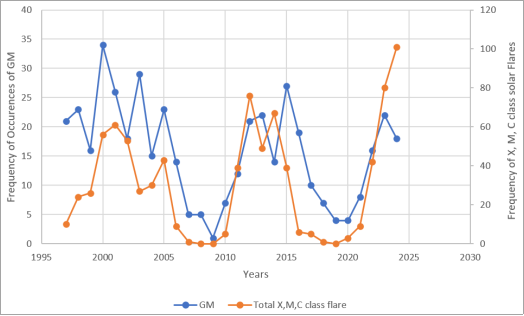
An analysis of geomagnetic storm activity and hard X-ray solar flare occurrence was carried out for the period 1997–2024. The results indicate that the annual frequency of intense geomagnetic storms (Dst ≤ −100 nT) exhibits a trend that generally follows the yearly mean occurrence of hard X-ray solar flares. Periods characterized by enhanced hard X-ray flare activity were found to coincide with increased frequencies of geomagnetic storms, suggesting a close association between solar eruptive processes and geomagnetic disturbances.
The statistical relationship between these two parameters was evaluated using correlation analysis. A positive correlation coefficient of r = 0.61 was obtained between the yearly frequency of geomagnetic storms and the yearly mean occurrence of hard X-ray solar flares. This moderate positive correlation indicates that years with greater hard X-ray flare activity tend to experience a higher occurrence of intense geomagnetic storms.
The observed relationship can be attributed to the fact that hard X-ray solar flares are manifestations of intense magnetic energy release in active solar regions. Such active regions are frequently associated with coronal mass ejections (CMEs) and enhanced solar wind disturbances, which are recognized as major drivers of geomagnetic storms. Although hard X-ray flares do not directly cause geomagnetic storms, their occurrence serves as an indicator of heightened solar activity and an increased probability of geoeffective solar eruptions.
The correlation coefficient obtained in this study suggests that hard X-ray solar flare activity contributes significantly to the variability of geomagnetic storm occurrence; however, the relationship is not sufficiently strong to imply direct causality. This indicates that additional interplanetary parameters, such as solar wind speed, plasma pressure, and the interplanetary magnetic field, also play critical roles in determining the intensity and frequency of geomagnetic storms. Nevertheless, the positive correlation confirms that hard X-ray solar flare occurrence can be considered a useful proxy for assessing long-term variations in geomagnetic storm activity and space weather conditions.
Figure 1. Shows Line Graph between frequency of occurrences of geomagnetic storm and yearly mean of occurrences hard X-ray solar flares during Solar Cycle 23, 24 and rising phase of 25.
3.2. Relationship Between Geomagnetic Storm Occurrence and Solar Wind Plasma Pressure
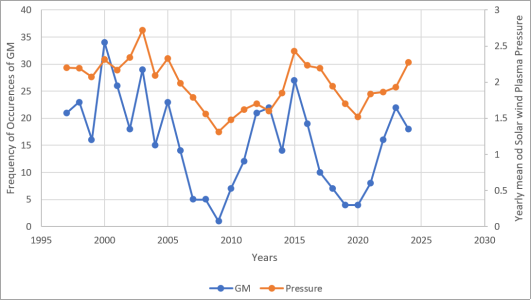
A comparative analysis of geomagnetic storm activity and solar wind plasma pressure was conducted for the period 1997–2024 to investigate the influence of solar wind conditions on the occurrence of intense geomagnetic storms. The results indicate that the annual frequency of geomagnetic storms with Dst ≤ −100 nT closely follows the variations in the yearly mean solar wind plasma pressure throughout the study period. Years characterized by elevated solar wind plasma pressure generally correspond to periods of increased geomagnetic storm occurrence.
The statistical relationship between these two parameters was quantified using correlation analysis. A positive correlation coefficient of r = 0.73 was obtained between the yearly frequency of geomagnetic storms and the yearly mean solar wind plasma pressure. This strong positive correlation suggests that enhanced solar wind plasma pressure is significantly associated with an increase in the occurrence of intense geomagnetic storms.
The observed relationship can be explained by the role of solar wind plasma pressure in governing solar wind–magnetosphere interactions. An increase in plasma pressure leads to greater compression of Earth's magnetosphere, resulting in enhanced magnetospheric currents and more efficient transfer of solar wind energy into the geospace environment. Such conditions favor the development of geomagnetic disturbances and increase the likelihood of storm generation.
The relatively high correlation coefficient obtained in this study indicates that solar wind plasma pressure is an important parameter influencing geomagnetic storm occurrence. Although geomagnetic storms are also controlled by other factors, including solar wind velocity, coronal mass ejections (CMEs), and the orientation and strength of the interplanetary magnetic field (IMF), the results demonstrate that variations in solar wind plasma pressure contribute substantially to the long-term variability of geomagnetic storm activity.
Therefore, the strong positive correlation between geomagnetic storm frequency and solar wind plasma pressure highlights the significance of solar wind dynamic conditions in driving geomagnetic disturbances and suggests that solar wind plasma pressure can serve as a valuable indicator for understanding and forecasting space weather phenomena.
Figure 2. Shows line graph between frequency of occurrences of geomagnetic storm and yearly mean of solar wind plasma pressure during solar cycle 23 and 24 and rising phase of 25.
3.3. Relationship Between Geomagnetic Storm Occurrence and Coronal Mass Ejections
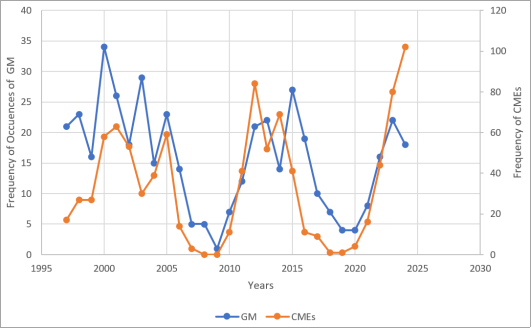
A statistical analysis was carried out to investigate the relationship between the occurrence of intense geomagnetic storms and coronal mass ejection (CME) activity during the period 1997–2024. The results show that the annual frequency of geomagnetic storms with Dst ≤ −100 nT generally follows the variation in the yearly mean occurrence of CMEs. Periods characterized by enhanced CME activity were found to correspond to increased frequencies of intense geomagnetic storms, indicating a close connection between solar eruptive events and geomagnetic disturbances.
To quantify this relationship, a correlation analysis was performed between the yearly frequency of geomagnetic storms and the yearly mean occurrence of CMEs. The analysis yielded a positive correlation coefficient of r = 0.63, indicating a moderate positive relationship between the two parameters. This result suggests that years with higher CME occurrence tend to experience a greater number of intense geomagnetic storms.
The observed correlation is consistent with the established understanding that CMEs are among the primary drivers of major geomagnetic storms. Coronal mass ejections involve the expulsion of large quantities of magnetized plasma from the solar corona into interplanetary space. When Earth-directed CMEs interact with the terrestrial magnetosphere, they can trigger significant geomagnetic disturbances, particularly when accompanied by strong and sustained southward interplanetary magnetic field components.
Although the correlation coefficient demonstrates a significant association between CME activity and geomagnetic storm occurrence, the moderate strength of the relationship suggests that not all CMEs are equally geoeffective. The impact of a CME on Earth's magnetosphere depends on several factors, including its propagation speed, magnetic field strength, direction of propagation, and magnetic field orientation upon arrival at Earth. Consequently, some CMEs may produce intense geomagnetic storms, whereas others may have little or no geomagnetic impact.
The positive correlation obtained in this study confirms that CME activity plays a crucial role in controlling long-term variations in geomagnetic storm occurrence. However, it also highlights the importance of considering additional solar and interplanetary parameters, such as solar wind speed, plasma pressure, and the interplanetary magnetic field, to achieve a more comprehensive understanding of geomagnetic storm generation.
Overall, the results demonstrate that coronal mass ejections constitute a significant source of geomagnetic disturbances and that their occurrence is closely associated with the frequency of intense geomagnetic storms during the study period. These findings further emphasize the importance of CME monitoring for space weather forecasting and the assessment of potential impacts on technological systems in near-Earth space and on the ground.
Figure 3. Shows line graph between frequency of occurrence of geomagnetic storms and yearly mean of coronal mass ejection during solar cycle 23, 24 and rising phase of 25.
3.4. Relationship Between Geomagnetic Storm Occurrence and the F10.7 Solar Radio Flux Index
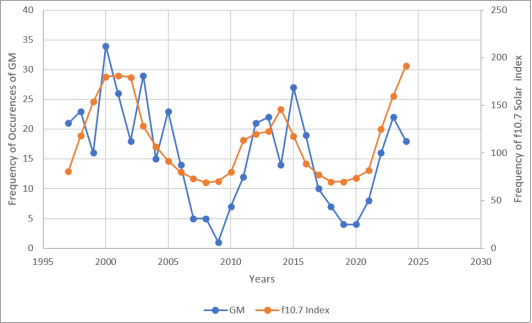
A statistical investigation was conducted to examine the relationship between the occurrence of intense geomagnetic storms and the F10.7 solar radio flux index during the period 1997–2024. The analysis revealed that the annual frequency of geomagnetic storms with Dst ≤ −100 nT generally follows the temporal variation of the yearly mean F10.7 solar index. Periods of elevated F10.7 values were found to coincide with increased frequencies of geomagnetic storms, indicating a close association between solar activity and geomagnetic disturbances.
To quantify this relationship, a correlation analysis was performed between the yearly frequency of geomagnetic storms and the yearly mean F10.7 solar index. The analysis yielded a positive correlation coefficient of r = 0.67, indicating a moderately strong positive relationship between the two parameters. This result suggests that years characterized by enhanced solar activity tend to experience a greater occurrence of intense geomagnetic storms.
The F10.7 solar radio flux index, measured at a wavelength of 10.7 cm (2800 MHz), is one of the most widely used indicators of overall solar activity. It serves as a reliable proxy for solar ultraviolet and extreme ultraviolet emissions and is closely related to the level of magnetic activity in the solar atmosphere. Consequently, variations in the F10.7 index reflect changes in the solar cycle and the occurrence of active solar regions capable of producing flares, coronal mass ejections (CMEs), and enhanced solar wind conditions.
The positive correlation observed in this study indicates that geomagnetic storm activity is influenced by long-term variations in solar activity. During periods of high solar activity, particularly near solar maximum, the increased occurrence of solar eruptions and interplanetary disturbances enhances the probability of geomagnetic storm generation. As a result, years with higher F10.7 values generally correspond to increased geomagnetic storm frequencies.
Although the correlation coefficient of 0.67 demonstrates a significant association between the F10.7 solar index and geomagnetic storm occurrence, it also suggests that geomagnetic storm activity is not controlled solely by the overall level of solar activity. The actual development of geomagnetic storms depends on additional factors, including the occurrence and geoeffectiveness of CMEs, solar wind plasma conditions, and the strength and orientation of the interplanetary magnetic field. Therefore, while the F10.7 index provides valuable information regarding the general state of solar activity, it should be considered alongside other solar and interplanetary parameters when assessing geomagnetic storm potential.
Overall, the results demonstrate that the F10.7 solar radio flux index is an important indicator of long-term geomagnetic storm variability. The positive correlation obtained in this study confirms that increased solar activity is associated with enhanced geomagnetic storm occurrence and highlights the usefulness of the F10.7 index in studies of solar-terrestrial interactions and space weather forecasting.
Figure 4. Shows line graph between frequency of occurrence of geomagnetic storms and yearly mean of F10.7 solar index during solar cycle 23, 24 and rising phase of 25.
3.5. Relationship Between Geomagnetic Storm Occurrence and the Interplanetary Magnetic Field
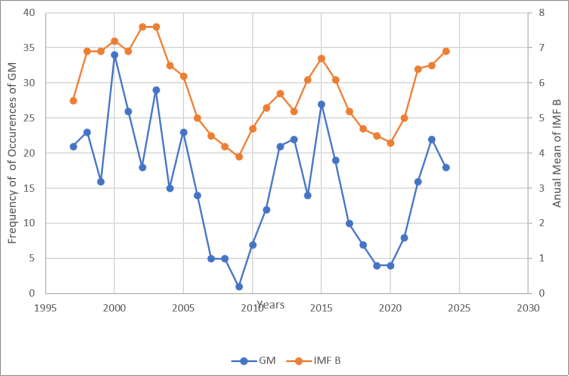
A detailed statistical analysis was performed to investigate the relationship between the occurrence of intense geomagnetic storms and variations in the interplanetary magnetic field (IMF) during the period 1997–2024. The results indicate that the annual frequency of geomagnetic storms with Dst ≤ −100 nT closely follows the temporal variation of the yearly mean interplanetary magnetic field. Periods characterized by enhanced IMF strength were generally associated with increased frequencies of intense geomagnetic storms, suggesting a strong connection between interplanetary magnetic conditions and geomagnetic activity.
To quantify this relationship, a correlation analysis was carried out between the yearly frequency of geomagnetic storms and the yearly mean IMF. The analysis yielded a positive correlation coefficient of r = 0.83, indicating a strong positive relationship between the two parameters. This is the highest correlation coefficient obtained among the solar and interplanetary parameters investigated in the present study, highlighting the dominant role of the IMF in controlling geomagnetic storm occurrence.
The observed strong correlation can be explained by the fundamental role of the interplanetary magnetic field in governing the interaction between the solar wind and Earth's magnetosphere. The IMF, which is carried outward from the Sun by the solar wind, directly influences the efficiency of energy transfer from the solar wind into the terrestrial magnetospheric system. Variations in IMF strength and orientation can significantly modify magnetospheric dynamics and geomagnetic activity.
In particular, when the IMF possesses a strong southward component (Bz< 0), magnetic reconnection occurs at the dayside magnetopause, allowing solar wind energy, plasma, and momentum to be efficiently transferred into Earth's magnetosphere. This process leads to enhanced ring current development, increased auroral activity, and the generation of intense geomagnetic storms. Consequently, years characterized by stronger interplanetary magnetic field conditions are more likely to experience a higher frequency of geomagnetic storms.
The high correlation coefficient obtained in this study demonstrates that the IMF is one of the most important controlling factors of geomagnetic storm activity. Compared with other solar activity indicators, such as hard X-ray solar flares, coronal mass ejections (CMEs), and the F10.7 solar radio flux index, the IMF exhibits a more direct influence on the physical processes responsible for geomagnetic storm generation. While solar eruptions and solar activity indices provide information about the sources of space weather disturbances, the IMF determines the extent to which these disturbances can effectively interact with Earth's magnetosphere.
The strong positive correlation (r = 0.83) therefore suggests that long-term variations in geomagnetic storm occurrence are closely linked to changes in interplanetary magnetic field conditions. This finding emphasizes the critical importance of IMF monitoring in space weather prediction and supports the use of IMF parameters as key indicators for forecasting geomagnetic storm activity.
Overall, the results demonstrate that the interplanetary magnetic field is the most influential parameter among those investigated in this study. Its strong association with geomagnetic storm frequency underscores its fundamental role in solar–terrestrial coupling processes and highlights its significance for understanding and predicting severe space weather events.
Figure 5. Shows line graph between frequency of occurrence of geomagnetic storms and yearly mean of interplanetary magnetic field during solar cycle 23, 24 and rising phase of 25.
4. Results
To investigate the influence of solar and interplanetary parameters on geomagnetic storm activity, a correlation analysis was performed between the yearly frequency of geomagnetic storm occurrences and selected indicators of solar and heliospheric activity. The parameters considered in this study include hard X-ray solar flares, solar wind plasma pressure, coronal mass ejections (CMEs), the F10.7 solar radio flux index, and the interplanetary magnetic field (IMF).
The analysis revealed that geomagnetic storm frequency exhibits positive correlations with all investigated parameters, indicating that increased solar and interplanetary activity is generally associated with a higher occurrence of geomagnetic storms.
A positive correlation coefficient of r = 0.73 was obtained between the yearly frequency of geomagnetic storms and the yearly mean solar wind plasma pressure. This strong correlation suggests that periods characterized by enhanced solar wind dynamic pressure are frequently associated with increased geomagnetic activity.
The relationship between geomagnetic storm frequency and the yearly mean occurrence of coronal mass ejections (CMEs) yielded a correlation coefficient of r = 0.63. Although lower than those observed for solar wind plasma pressure and the IMF, this value still indicates a substantial positive association, confirming the important role of CMEs in producing geomagnetic disturbances.
The correlation coefficient between geomagnetic storm frequency and the yearly mean F10.7 solar radio flux index was found to be r = 0.67. Since the F10.7 index is a widely accepted measure of solar activity and a proxy for solar ultraviolet radiation, this result suggests that enhanced solar activity levels contribute to increased geomagnetic storm occurrence.
The strongest relationship was observed between geomagnetic storm frequency and the yearly mean interplanetary magnetic field, with a correlation coefficient of r = 0.83. This value indicates a very strong positive association and highlights the dominant influence of interplanetary magnetic field conditions on geomagnetic storm generation.
Furthermore, a positive correlation was observed between geomagnetic storm frequency and the yearly mean occurrence of hard X-ray solar flares. This finding indicates that years with increased flare activity tend to experience a higher frequency of geomagnetic storms, reflecting the contribution of intense solar eruptive events to space weather disturbances.
Overall, the correlation coefficients suggest the following order of influence on geomagnetic storm occurrence:
IMF (r = 0.83) > Solar Wind Plasma Pressure (r = 0.73) > F10.7 Solar Index (r = 0.67) > CME Occurrence (r = 0.63).
The results demonstrate that geomagnetic storm activity is strongly connected to both solar activity indicators and interplanetary conditions.
5. Discussion
Geomagnetic storms are among the most significant manifestations of solar-terrestrial interactions and arise primarily from disturbances in the solar wind and interplanetary magnetic field that interact with Earth's magnetosphere. The positive correlations obtained in this study provide valuable insight into the physical mechanisms linking solar activity to geomagnetic storm occurrence.
The strong positive correlation (r = 0.73) between geomagnetic storm frequency and solar wind plasma pressure indicates that increased pressure in the solar wind contributes significantly to geomagnetic disturbances. Elevated solar wind pressure compresses the magnetosphere, enhances magnetospheric currents, and facilitates the transfer of solar wind energy into the near-Earth environment. Consequently, years characterized by stronger solar wind conditions tend to exhibit a greater frequency of geomagnetic storms.
The positive correlation between geomagnetic storm frequency and CME occurrence (r = 0.63) supports numerous previous studies that identify CMEs as major drivers of intense geomagnetic storms. CMEs transport large clouds of magnetized plasma from the Sun into interplanetary space. When directed toward Earth, these structures can interact with the magnetosphere and trigger geomagnetic storms, particularly when accompanied by strong southward magnetic field components. The moderate strength of the correlation suggests that although CMEs are important, not all CMEs are geoeffective, and additional factors such as CME speed, direction, and magnetic orientation influence storm generation.
The correlation coefficient of r = 0.67 between geomagnetic storm frequency and the F10.7 solar radio flux index indicates that geomagnetic storm occurrence generally follows variations in the solar cycle. The F10.7 index reflects overall solar activity and is closely related to sunspot numbers, ultraviolet emissions, and magnetic activity on the Sun. During solar maximum periods, elevated solar activity increases the likelihood of flares, CMEs, and enhanced solar wind conditions, thereby increasing geomagnetic storm frequency.
The strongest correlation observed in this study was between geomagnetic storm frequency and the interplanetary magnetic field (r = 0.83). This result emphasizes the fundamental role of the IMF in solar wind–magnetosphere coupling processes. The southward component of the IMF is particularly important because it promotes magnetic reconnection at the dayside magnetopause, enabling efficient transfer of solar wind energy into Earth's magnetosphere. Enhanced reconnection processes intensify geomagnetic activity and increase the probability of storm occurrence. The high correlation coefficient indicates that IMF variations are among the most reliable indicators of geomagnetic storm activity.
The positive association between hard X-ray solar flare occurrence and geomagnetic storm frequency further highlights the influence of energetic solar phenomena on space weather conditions. Hard X-ray flares are signatures of intense energy release in the solar atmosphere and are frequently associated with CME eruptions and energetic particle events. Although solar flares alone do not necessarily cause geomagnetic storms, their occurrence often indicates active solar regions capable of producing geoeffective CMEs and other disturbances. Therefore, increased hard X-ray flare activity can be considered an indirect indicator of enhanced geomagnetic storm potential.
The combined results suggest that geomagnetic storm occurrence is governed by a complex interaction between solar eruptive activity and interplanetary conditions. While solar flares, CMEs, and the F10.7 index provide information about activity levels at the Sun, the solar wind plasma pressure and interplanetary magnetic field directly influence the efficiency with which solar disturbances impact Earth's magnetosphere.
6. Conclusion
This study examined the relationship between the yearly frequency of geomagnetic storm occurrences and various solar and interplanetary parameters through correlation analysis. The results revealed significant positive relationships between geomagnetic storm activity and all investigated parameters, confirming the strong influence of solar and heliospheric processes on geomagnetic disturbances.
The frequency of geomagnetic storms was positively correlated with solar wind plasma pressure (r = 0.73), CME occurrence (r = 0.63), the F10.7 solar radio flux index (r = 0.67), and the interplanetary magnetic field (r = 0.83). A positive relationship was also identified between geomagnetic storm frequency and hard X-ray solar flare occurrence.
Among all parameters considered, the interplanetary magnetic field exhibited the strongest correlation with geomagnetic storm frequency, emphasizing its critical role in controlling energy transfer from the solar wind into Earth's magnetosphere. Solar wind plasma pressure also showed a strong influence, while CME occurrence and solar activity indices demonstrated moderate but significant relationships with geomagnetic storm occurrence.
The findings indicate that geomagnetic storm activity is controlled by both the level of solar activity and the interplanetary conditions through which solar disturbances propagate. Understanding these relationships is essential for improving space weather forecasting and mitigating the adverse effects of geomagnetic storms on satellite operations, communication systems, navigation technologies, and power grid infrastructure. Future studies incorporating additional parameters, such as solar wind speed, the southward IMF component (Bz), sunspot number, and geomagnetic indices, may provide a more comprehensive understanding of the mechanisms responsible for geomagnetic storm generation.
Abbreviations
CMES | Coronal Mass Ejections |
IMF | Interplanetary Magnetic Field |
ICMEs | Interplanetary Coronal Mass Ejections |
Acknowledgments
The authors gratefully acknowledge the Solar and Heliospheric Observatory (SOHO) mission team for providing LASCO and EIT data used in the identification and analysis of coronal mass ejections (CMEs). We thank NASA's Space Physics Data Facility for access to the OMNI database, which provided Dst index and solar wind plasma data. We also acknowledge the National Oceanic and Atmospheric Administration (NOAA) and the U.S. Department of Commerce for making available Solar Geophysical Data Reports and Solar-Terrestrial Physics (STP) datasets used in this study. The authors appreciate the efforts of all scientific teams i The authors express their sincere gratitude to Dr. Rajendra Prasad Kumhar, Department of Physics, Maharaja Chhatrasal Bundelkhand University, Chhatarpur, Madhya Pradesh, and Dr. Preetam Singh Gour, National University, Jaipur, Rajasthan, for their valuable guidance, encouragement, and continuous support throughout this research work. involved in the collection, processing, and dissemination of these valuable datasets.
Author Contributions
Anshu Gupta: Conceptualization, Formal Analysis, Investigation, Methodology, Resources, Software, Writing – original draft
Nand Kumar Patel: Conceptualization, Data curation, Formal Analysis, Methodology, Resources, Validation, Writing – review & editing
Pyare Lal Verma: Methodology, Project administration, Resources, Supervision, Validation, Writing – review & editing
Conflicts of Interest
The authors declare no conflicts of interest.
References
| [1] |
Dungey, J. W. (1961). Interplanetary magnetic field and the auroral zones. Physical Review Letters.
|
| [2] |
Gonzalez, W. D., Joselyn, J. A., Kamide, Y., et al. (1994). What is a geomagnetic storm? Journal of Geophysical Research: Space Physics.
|
| [3] |
Kilpua, E. K. J., et al. (2017). Coronal mass ejections and geomagnetic storms. Living Reviews in Solar Physics.
|
| [4] |
MNRAS (2023). Geomagnetic storm forecasting from coronal holes. Monthly Notices of the Royal Astronomical Society.
|
| [5] |
Pal, S. et al. (2025). Magnetic interaction of multiple ICMEs leading to a historic storm (May 2024). arXiv: 2508.16780.
|
| [6] |
Paouris, E. et al. (2025). How the CME on 21 April 2023 triggered a severe geomagnetic storm. arXiv: 2503.00705.
|
| [7] |
Richardson, I. G., & Cane, H. V. (2012). Solar wind drivers of geomagnetic storms. Solar Physics.
|
| [8] |
Schwenn, R. (2006). Space weather: The solar perspective. Living Reviews in Solar Physics.
|
| [9] |
Teng, W. et al. (2024). Unexpected major geomagnetic storm caused by faint flux rope eruption. Nature Communications.
|
| [10] |
Webb, D. F., & Howard, T. A. (2012). Coronal mass ejections: Observations. Living Reviews in Solar Physics.
|
| [11] |
Zhang, M. et al. (2023). Numerical modeling of solar wind and CME in the inner heliosphere. Frontiers in Astronomy and Space Sciences.
|
Cite This Article
-
APA Style
Gupta, A., Patel, N. K., Verma, P. L. (2026). Heliospheric Origins of Intense Geomagnetic Storms: Evidence from Solar Cycles 23, 24, and Rising Phase of 25. International Journal of Astrophysics and Space Science, 14(2), 29-38. https://doi.org/10.11648/j.ijass.20261402.12
 Copy
|
Copy
|
 Download
ACS Style
Gupta, A.; Patel, N. K.; Verma, P. L. Heliospheric Origins of Intense Geomagnetic Storms: Evidence from Solar Cycles 23, 24, and Rising Phase of 25. Int. J. Astrophys. Space Sci. 2026, 14(2), 29-38. doi: 10.11648/j.ijass.20261402.12
Copy
|
Download
AMA Style
Gupta A, Patel NK, Verma PL. Heliospheric Origins of Intense Geomagnetic Storms: Evidence from Solar Cycles 23, 24, and Rising Phase of 25. Int J Astrophys Space Sci. 2026;14(2):29-38. doi: 10.11648/j.ijass.20261402.12
Copy
|
Download
-
@article{10.11648/j.ijass.20261402.12,
  author = {Anshu Gupta and Nand Kumar Patel and Pyare Lal Verma},
  title = {Heliospheric Origins of Intense Geomagnetic Storms: Evidence from Solar Cycles 23, 24, and Rising Phase of 25},
  journal = {International Journal of Astrophysics and Space Science},
  volume = {14},
  number = {2},
  pages = {29-38},
  doi = {10.11648/j.ijass.20261402.12},
  url = {https://doi.org/10.11648/j.ijass.20261402.12},
  eprint = {https://article.sciencepublishinggroup.com/pdf/10.11648.j.ijass.20261402.12},
  abstract = {Understanding the drivers of geomagnetic storm activity is essential for advancing space weather forecasting and mitigating the impacts of solar-terrestrial disturbances on technological systems. In this study, the influence of key solar and interplanetary parameters on geomagnetic storm occurrence was investigated through a correlation analysis between the yearly frequency of geomagnetic storms and selected indicators of solar and heliospheric activity. The parameters examined include hard X-ray solar flares, solar wind plasma pressure, coronal mass ejection (CME) occurrence, the F10.7 solar radio flux index, and the interplanetary magnetic field (IMF). The results reveal statistically significant positive relationships between geomagnetic storm frequency and all investigated parameters, indicating that enhanced solar and interplanetary activity generally promotes increased geomagnetic disturbances. Among the studied variables, the strongest correlation was observed between geomagnetic storm frequency and the yearly mean IMF (r = 0.83), emphasizing the dominant role of interplanetary magnetic field conditions in storm generation and magnetosphere-solar wind coupling processes. A strong positive correlation was also found with solar wind plasma pressure (r = 0.73), suggesting that elevated solar wind dynamic pressure significantly contributes to geomagnetic storm occurrence. The F10.7 solar radio flux index exhibited a substantial positive correlation (r = 0.67), indicating that higher levels of solar activity are associated with increased geomagnetic storm frequency. Similarly, CME occurrence showed a positive correlation (r = 0.63), confirming the important contribution of large-scale solar eruptive events to geomagnetic disturbances. Furthermore, hard X-ray solar flare activity demonstrated a positive association with storm occurrence, highlighting the role of energetic solar eruptions in shaping space weather variability. The comparative analysis establishes the relative influence of the investigated parameters in the following order: IMF (r = 0.83) > Solar Wind Plasma Pressure (r = 0.73) > F10.7 Solar Flux (r = 0.67) > CME Occurrence (r = 0.63). These findings demonstrate that geomagnetic storm activity is governed by a complex interplay between solar activity and interplanetary conditions, with IMF variability emerging as the most influential factor. The study contributes to a deeper understanding of solar-terrestrial interactions and provides valuable insights for improving predictive models of geomagnetic storm occurrence and space weather hazards.},
 year = {2026}
}
Copy
|
Download
-
TY  - JOUR
T1  - Heliospheric Origins of Intense Geomagnetic Storms: Evidence from Solar Cycles 23, 24, and Rising Phase of 25
AU  - Anshu Gupta
AU  - Nand Kumar Patel
AU  - Pyare Lal Verma
Y1  - 2026/07/24
PY  - 2026
N1  - https://doi.org/10.11648/j.ijass.20261402.12
DO  - 10.11648/j.ijass.20261402.12
T2  - International Journal of Astrophysics and Space Science
JF  - International Journal of Astrophysics and Space Science
JO  - International Journal of Astrophysics and Space Science
SP  - 29
EP  - 38
PB  - Science Publishing Group
SN  - 2376-7022
UR  - https://doi.org/10.11648/j.ijass.20261402.12
AB  - Understanding the drivers of geomagnetic storm activity is essential for advancing space weather forecasting and mitigating the impacts of solar-terrestrial disturbances on technological systems. In this study, the influence of key solar and interplanetary parameters on geomagnetic storm occurrence was investigated through a correlation analysis between the yearly frequency of geomagnetic storms and selected indicators of solar and heliospheric activity. The parameters examined include hard X-ray solar flares, solar wind plasma pressure, coronal mass ejection (CME) occurrence, the F10.7 solar radio flux index, and the interplanetary magnetic field (IMF). The results reveal statistically significant positive relationships between geomagnetic storm frequency and all investigated parameters, indicating that enhanced solar and interplanetary activity generally promotes increased geomagnetic disturbances. Among the studied variables, the strongest correlation was observed between geomagnetic storm frequency and the yearly mean IMF (r = 0.83), emphasizing the dominant role of interplanetary magnetic field conditions in storm generation and magnetosphere-solar wind coupling processes. A strong positive correlation was also found with solar wind plasma pressure (r = 0.73), suggesting that elevated solar wind dynamic pressure significantly contributes to geomagnetic storm occurrence. The F10.7 solar radio flux index exhibited a substantial positive correlation (r = 0.67), indicating that higher levels of solar activity are associated with increased geomagnetic storm frequency. Similarly, CME occurrence showed a positive correlation (r = 0.63), confirming the important contribution of large-scale solar eruptive events to geomagnetic disturbances. Furthermore, hard X-ray solar flare activity demonstrated a positive association with storm occurrence, highlighting the role of energetic solar eruptions in shaping space weather variability. The comparative analysis establishes the relative influence of the investigated parameters in the following order: IMF (r = 0.83) > Solar Wind Plasma Pressure (r = 0.73) > F10.7 Solar Flux (r = 0.67) > CME Occurrence (r = 0.63). These findings demonstrate that geomagnetic storm activity is governed by a complex interplay between solar activity and interplanetary conditions, with IMF variability emerging as the most influential factor. The study contributes to a deeper understanding of solar-terrestrial interactions and provides valuable insights for improving predictive models of geomagnetic storm occurrence and space weather hazards.
VL  - 14
IS  - 2
ER  -
Copy
|
Download





 Share This Article
 Twitter
 Linked In
 Facebook